

As the core equipment connecting distribution centers, transportation vehicles and terminal stores, Roll Containers are mainly divided into four basic types. For professional purchasers and logistics managers, understanding the basic knowledge of these four types is not only crucial for ensuring the scientific selection of equipment, but also essential for optimizing operational efficiency and controlling lifecycle costs.
I.Detachable Roll Container
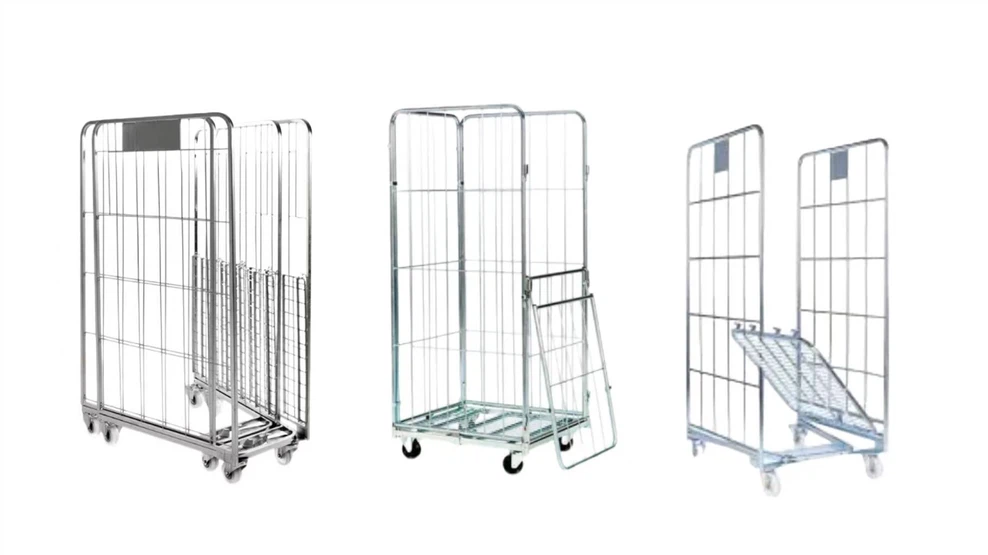
1. Definition and Characteristics
Detachable means that the upper structures such as side walls and partitions can be completely separated from the base. The core of this design lies in the base, which serves as a universal platform with wheels, and can be used with various upper structures to achieve the concept of "one base for multiple uses".
2. Design Principles and Technical Points
The key to detachability lies in the design of the connecting mechanism. High-quality products often adopt quick locking devices, which enables staff to complete the disassembly of the side walls without tools, and the strength and durability of the connection points are also in line with the design requirements, ensuring that the container will not fall off even under full-load transportation.
The base of the container usually adopts a Z-shaped or H-shaped frame, equipped with corners, and closely matches the positioning pin holes of the upper structure to ensure the smoothness of disassembly and the stability of stacking.
3. Core Application Value
- Maintenance Economy: When the side walls are damaged due to collision, the Roll Container does not need to be scrapped as a whole, only the components can be replaced to resume use. The cost-saving brought by this maintainability is extremely significant.
- Function Conversion: The same base can be used for clothing distribution in the morning and household appliances distribution in the afternoon, significantly improving asset utilization.
4. Applicable Scenarios
- Logistics centers with mixed distribution of multiple categories
- Long-term operation requiring frequent component replacement
- Leasing models hoping to maximize asset flexibility
II.Foldable Roll Container
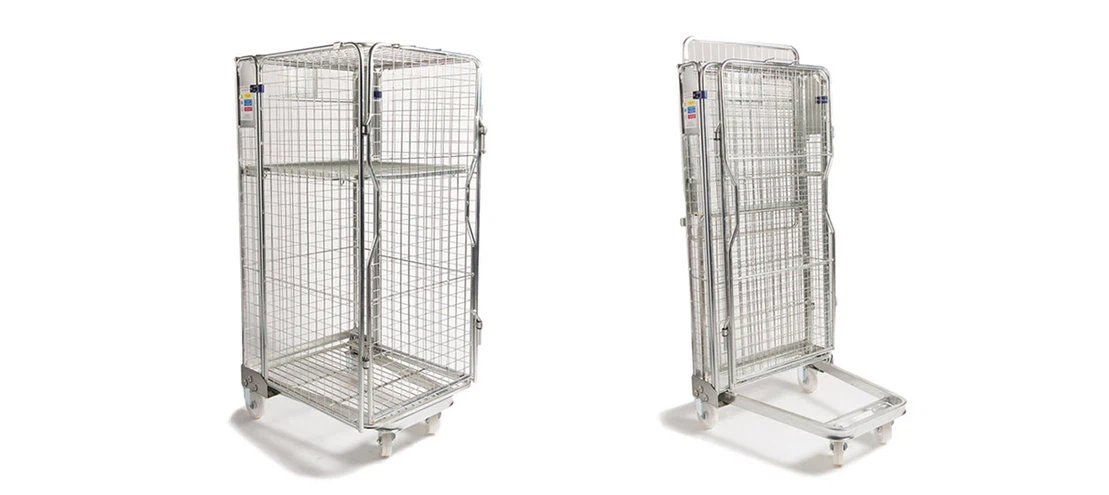
1. Definition and Characteristics
Foldable Roll Container means that the side panels can be folded backward or towards the base. This design aims to significantly reduce the volume when empty, effectively solving the industry problem of space waste caused by empty return trips.
2. Design Principles and Technical Points
The technical core of the foldable design lies in the hinge structure and locking device. The connection between the side panels and the base uses precise hinges. The locking mechanism in the folded state needs a clear range of position to prevent accidental unfolding during transportation.
The design of folding must pass dynamic stability tests to ensure that the folding components will not accidentally unlock due to vibration under full-load conditions.
3. Core Application Value
- Return Logistics Cost Control: For the phenomenon of "heavy outbound and empty return" commonly found in distribution networks, the foldable Roll Container can recover equipment investment by saving transportation costs.
- Warehouse Space Optimization: Hundreds of Roll Containers can be folded for storage, releasing ground space for other business activities, saving thousands of yuan in warehouse rent annually.
4. Applicable Scenarios
- Retail locations such as supermarkets and convenience stores
- Logistics routes with an empty return rate of over 30%
- Locations with precious warehouse space and needing to flexibly respond to inventory fluctuations
III.Nested Roll Container
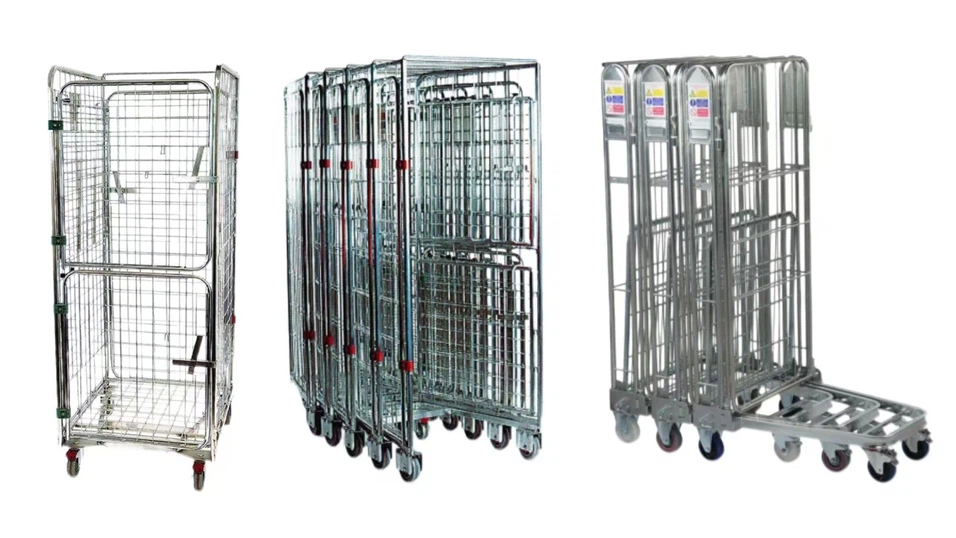
1. Definition and Characteristics
Nested Roll Container refers to a cone-shaped or A-shaped structure, allowing multiple empty containers to be pushed into each other's interiors, forming a compact unit combination, which is the most efficient way to store empty containers in terms of space efficiency.
2. Design Principles
The key to the nested design lies in the tapering design and positioning mechanism. The side walls of the Roll Container are usually inclined at an angle of 5° to 8°, enabling one Roll Container to be smoothly pushed into the interior of another. There are also dedicated positioning holes at the bottom to ensure the stability after nesting.
The nested design also has specific requirements for casters. Some products' casters adopt a concealed design, embedded in the base, to avoid interference during nesting. Some high-end products even come with guide wheels, making the operation smoother during nesting.
3. Core application value
- Ultimate space efficiency: When 5 Roll Containers are nested, they only occupy the floor space of one container, achieving a space saving rate of up to 80%. This feature is of great value for urban distribution centers, fresh food cold chain warehouses, etc.
- Zero operation time: The folding type requires manual folding design, but the nested type only needs to push the empty Roll Container in, without any additional actions, making it very suitable for high-frequency turnover scenarios that require every second counts.
4. Application scenarios
- Logistics distribution centers
- Fresh food cold chain warehouses
- Operations venues that require high frequency turnover and ultimate efficiency
IV.Fixed Roll Container

1. Definition and features
Fixed Roll Container refers to a container type where the side plates are permanently linked to the base and cannot be folded or disassembled. This is the most traditional and simplest design.
2. Design principle
The structure of the fixed type is the simplest and most reliable. The side plates and the base are usually permanently fixed to form a complete frame. Since it has no moving parts, the strength of the fixed Roll Container is the highest. Under the same conditions, its load-bearing capacity is often higher than that of other types of Roll Containers.
The design of the fixed type does not need to consider folding mechanisms or tapering angles, so the manufacturing cost is relatively lower, usually 20%-30% lower than that of the folding or nested types of the same specification.
3. Core application value
- Cost economy: Without additional design, for dedicated scenarios with fixed routes and high return-load rates, the fixed type is the most economical choice, and the maintenance requirements are also lower.
- Structural reliability: Without moving parts, the structure is strong and has a high load-bearing capacity.
4. Application scenarios
- Factory internal logistics
- Dedicated line circulation distribution
- Applications in harsh environments (dust, outdoors)
With the continuous increase in land costs and the increasingly precious availability of labor resources, choosing the most suitable solution based on the actual operational scenario is to select the most efficient operation and the highest return on investment.
If you are interested in our products or have any questions, please feel free to contact us at any time!


