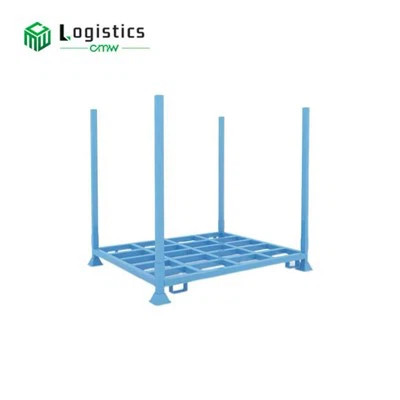

As a supplier of Racks for Tires, I've witnessed firsthand the importance of flexibility in tire placement within these racks. The flexibility of tire racks plays a crucial role in optimizing storage space, ensuring efficient access to tires, and accommodating various tire sizes and types. In this blog, I'll delve into the different aspects of flexibility in tire racks and how it benefits businesses in the automotive industry.
1. Adaptability to Different Tire Sizes
One of the primary indicators of a flexible tire rack is its ability to handle a wide range of tire sizes. Tires come in various diameters, widths, and aspect ratios, from small compact car tires to large truck and tractor tires. A good tire rack should be adjustable to accommodate these differences.
For instance, some racks feature adjustable arms or dividers. These can be moved along a track or re - positioned to create compartments of different sizes. This allows businesses to store tires of various dimensions side by side. Whether you're dealing with a set of 15 - inch passenger car tires or 22 - inch SUV tires, the rack can be customized to fit them all. Our Racks for Tires are designed with this adaptability in mind, ensuring that no matter the size of the tire inventory, the rack can be configured to meet the storage needs.
2. Vertical and Horizontal Placement Options
Flexibility also extends to the way tires can be placed within the rack. Tires can be stored either vertically or horizontally, depending on the available space and the type of access required.
Vertical storage is ideal for maximizing floor space. When tires are stacked vertically, more tires can be stored in a given area. This is particularly useful for warehouses with limited floor space. On the other hand, horizontal storage provides easier access to individual tires. It allows for quick identification and retrieval of specific tires, which is beneficial in a busy tire shop where technicians need to grab the right tire promptly.
Our racks offer both vertical and horizontal placement options. They can be easily reconfigured to switch between the two storage methods. For example, if a business experiences a change in its tire inventory or workflow, the rack can be adjusted accordingly. This versatility ensures that the rack can adapt to different operational requirements over time.
3. Modular Design for Expandability
A flexible tire rack should have a modular design that allows for easy expansion. As a business grows and its tire inventory increases, the storage capacity needs to be expanded as well. A modular rack system can be added to incrementally, without the need for a complete overhaul of the storage setup.
Our Portable Tire Rack is a great example of a modular solution. It can be connected to other racks to create a larger storage unit. This not only provides the flexibility to expand but also allows for easy re - arrangement of the storage layout. If a new section of the warehouse becomes available, the racks can be moved and re - assembled to make the most of the new space.
4. Compatibility with Different Tire Types
In addition to different sizes, tires come in various types, such as radial, bias - ply, and run - flat tires. Each type may have different storage requirements. For example, run - flat tires may need to be stored in a way that minimizes stress on the sidewalls.
Our tire racks are designed to be compatible with all types of tires. They provide a stable and secure storage environment for different tire constructions. Whether it's a high - performance radial tire or a heavy - duty bias - ply tire, the rack ensures that the tires are stored in a way that maintains their integrity.
5. Ease of Reconfiguration
The flexibility of a tire rack is also measured by how easily it can be reconfigured. In a dynamic business environment, changes are inevitable. A tire shop may need to adjust its storage layout to accommodate a new product line or to improve workflow efficiency.
Our racks are designed with simplicity in mind. They can be reconfigured quickly and with minimal tools. This means that businesses can make changes to their tire storage setup without significant downtime. Whether it's adding or removing dividers, changing the orientation of the racks, or expanding the storage area, the process is straightforward and can be completed in a short amount of time.
6. Mobility for Flexibility in Use
Some tire racks are designed to be mobile, which adds another layer of flexibility. A Portable Tire Rack can be moved around the warehouse or even taken to different locations. This is useful for tire shops that need to display tires at trade shows or for mobile tire installation services.
The mobility of the rack allows for on - the - spot tire storage and organization. It can be positioned wherever it's needed, whether it's near the service area in a tire shop or at a customer's location for a mobile installation. This flexibility ensures that businesses can adapt to different situations and provide better service to their customers.
7. Compatibility with Automated Storage Systems
In modern warehouses, there is an increasing trend towards automation. A flexible tire rack should be compatible with automated storage and retrieval systems (AS/RS). This allows for seamless integration into an automated warehouse environment.
Our racks are designed to work with AS/RS technology. They can be easily incorporated into an automated system, which improves the efficiency of tire storage and retrieval. The automated system can accurately identify and retrieve the required tires, reducing the time and effort involved in manual searching.
8. Customization Options
To meet the specific needs of different businesses, our tire racks offer a range of customization options. Customization can include features such as special coatings for corrosion resistance, different colors for better visibility, or specific labeling systems.
Businesses can also request custom - sized racks to fit their unique warehouse space. This level of customization ensures that the tire rack is tailored to the exact requirements of the business, providing the ultimate in flexibility.


Conclusion
The flexibility of racks for tires in terms of tire placement is a critical factor for businesses in the automotive industry. It allows for efficient use of space, easy access to tires, and the ability to adapt to changing business needs. Our Racks for Tires are designed to offer all these benefits and more. With features such as adaptability to different tire sizes, vertical and horizontal placement options, modular design, and mobility, our racks provide a comprehensive solution for tire storage.
If you're in the market for a flexible tire rack that can meet your specific needs, we invite you to reach out to us for a detailed discussion. Our team of experts is ready to assist you in finding the perfect tire rack solution for your business. Contact us today to start the conversation about optimizing your tire storage with our high - quality, flexible racks.
References
- Automotive Warehouse Management Best Practices, Industry Research Report, 20XX
- Tire Storage and Handling Guidelines, Tire Manufacturers Association, 20XX
- Automated Storage and Retrieval Systems in the Automotive Industry, Journal of Logistics and Supply Chain Management, 20XX